Gulf War Syndrome is not a term that is used by the United States Department of Veteran Affairs. The VA refers to the illnesses experienced by Gulf War Veterans as 'Chronic Multisymptom Illness' (CMI). Through reading 'The Untold History of the United States' I came across the term Gulf War Syndrome and was intrigued by the prospect, drawing me to conduct further research, since the mention of the syndrome in the book was brief and left an aura of mystery surrounding the claim. The book mentions the use of depleted uranium on what is referred to as the "highway of death". There is a brief mention of the claim that this new chemical weapon could have claimed victims from the U.S. forces, who now experience illness classified as Gulf War Syndrome.
Through researching the syndrome, my understanding of the reality behind this illness was not clarified--if anything it was further clouded when stumbling upon the 'politically correct' term of 'Chronic Multisymptom Illness'. The VA asserts that the symptoms are so vast and differing with no singularly identified cause that it is not correct to refer to the ailments of the Gulf War Veterans as Gulf War Syndrome; which seems to suggest the same symptoms and cause. According to the VA, primary symptoms are: fatigue, headaches, joint pain, indigestion, insomnia, dizziness, respiratory disorders, and memory problems. One-third of active U.S. military in the Gulf War have experienced at least two of these symptoms, chronically (According to a Report Brief on the Gulf War and Health). The Report referenced prior was the only source I found which mentioned the possibility of "chemical and biological agents" as the culprit.
Since the symptoms of Gulf War Veterans are so vast and the government and military agencies are highly skilled in covering up past wrongs during warfare, I am not very surprised by the lack of concrete information behind the Gulf War Syndrome (or CMI) experienced by veterans. When beginning my research I figured there would be more reliable material with more concrete information on the syndrome, such as can be found with Agent Orange, but that is just simply not the case here. All we can hope for is time to reveal the truth of these illnesses, as for now, at least the ailments of these veterans are being recognized, researched, and treated--whether we're calling it CMI or Gulf War Syndrome is something that will have to be dealt with in time.
Tuesday, April 30, 2013

Tuesday, April 23, 2013
Reagan's Hostages
As we discussed in class, the Iran Contra scandal as a whole is suspicious, but here I'd like to address the way in which the Reagan Administration has been implicated in facilitating a hostage situation--and got away with it!
I retrieved this quote from Consortium News:
"In a Christian Science Monitor commentary about the movie “Argo,” Bani-Sadr wrote that “Ayatollah Khomeini and Ronald Reagan had organized a clandestine negotiation … which prevented the attempts by myself and then-U.S. President Jimmy Carter to free the hostages before the 1980 U.S. presidential election took place. The fact that they were not released tipped the results of the election in favor of Reagan...two of my advisors, Hussein Navab Safavi and Sadr-al-Hefazi, were executed by Khomeini’s regime because they had become aware of this secret relationship between Khomeini, his son Ahmad, … and the Reagan administration.”
(Here is a link to the full commentary by Bani-Sadr on Christian Science Monitor.)
The negotiation between Reagan and Khomeini was later know as "October Surprise".
(Note: Ayatollah Khomeini was a religious and political leader who made Iran the world's first Islamic Republic in 1979, where Bani-Sadr became the first president in 1980. According to BBC. )
By cutting a deal with Iranian leaders to delay the release of American hostages Reagan and his administration facilitated a hostage situation.
Bani-Sadr's information came out in a letter dated December 17, 1992, but by the time it came out the House Task Force conducting the investigation on the Reagan Administration made the decision to dismiss the evidence and declare the Regan Administration and Campaign innocent. The House Task Force made this decision even after being asked to extend the investigation three months.
As we can see, Reagan and his Administration were pretty good at cutting deals, so we can't find this information that surprising--just offensive to the integrity of our Nation.

The New York Times crediting Reagan with the release of the hostages in Iran. Courtesy of Iranian.com.
I retrieved this quote from Consortium News:
"In a Christian Science Monitor commentary about the movie “Argo,” Bani-Sadr wrote that “Ayatollah Khomeini and Ronald Reagan had organized a clandestine negotiation … which prevented the attempts by myself and then-U.S. President Jimmy Carter to free the hostages before the 1980 U.S. presidential election took place. The fact that they were not released tipped the results of the election in favor of Reagan...two of my advisors, Hussein Navab Safavi and Sadr-al-Hefazi, were executed by Khomeini’s regime because they had become aware of this secret relationship between Khomeini, his son Ahmad, … and the Reagan administration.”
(Here is a link to the full commentary by Bani-Sadr on Christian Science Monitor.)
The negotiation between Reagan and Khomeini was later know as "October Surprise".
(Note: Ayatollah Khomeini was a religious and political leader who made Iran the world's first Islamic Republic in 1979, where Bani-Sadr became the first president in 1980. According to BBC. )
By cutting a deal with Iranian leaders to delay the release of American hostages Reagan and his administration facilitated a hostage situation.
Bani-Sadr's information came out in a letter dated December 17, 1992, but by the time it came out the House Task Force conducting the investigation on the Reagan Administration made the decision to dismiss the evidence and declare the Regan Administration and Campaign innocent. The House Task Force made this decision even after being asked to extend the investigation three months.
As we can see, Reagan and his Administration were pretty good at cutting deals, so we can't find this information that surprising--just offensive to the integrity of our Nation.

Sunday, April 14, 2013
Linda Lovelace on the big screen again
I found the story of Linda Lovelace's life before and after "Deep Throat" to be very interesting--and apparently so did American film makers when introducing the movie "Lovelace" in 2013. Rob Epstein and Jeffery Friedman directed the biopic about Linda Lovelace's life before and after her debut in "Deep Throat"--Epstein and Friedman also directed "The Times of Harvey Milk", which I found particularly interesting and ironic, since we viewed "Inside Deep Throat" (about Lovelace) and we will now be viewing "The Times of Harvey Milk", werid. Anyways, the film was shown at this year's Sundance Film Festival and achieved an 83% approval rating on Rotten Tomatoes; 97% recommend seeing the film. I'm intrigued! I also found it interesting and ironic that Lindsay Lohan was originally cast to play Linda Lovelace in another biopic of her life titled "Inferno. Lohan and Lovelace have relentless, negative attention in the spotlight in common. From the description of "Lovelace" the story doesn't much differ from any other mainstream speculation about the 70's adult film star's relationship with the porn industry--she is portrayed as a victim at the hands of her first husband, Chuck Traynor, forced into performing sexual acts that had her thrust into the American spotlight with a negative connotation. This is the story Lovelace stuck with when joining the feminist party, doing television and radio interviews, and writing her book; but by the testimony of the film makers in "Inside Deep Throat" she was not victimized or forced into doing anything on the set of "Deep Throat". One of the film makers described her as a "puppet", she always needed someone to tell her what to do and how to think--whether that was her first husband or the feminists, she always had someone behind her regulating her behaviors and thoughts. Of course you couldn't expect them to admit to any foul play on the set of their already controversial film, especially after they saw Reems under fire. The true story of Linda Lovelace may never be known, but I find it interesting that in 2013 they are still trying to figure it out.

Above is a photo of Lindsay Lohan posing as Linda Lovelace on the cover of "Inferno", courtesy of the Huffington Post.

This photo is of Amanda Seyfried posing as Linda Lovelace in this year's new release, "Lovelace. Photo courtesy of imdb.com.

Above is a photo of Lindsay Lohan posing as Linda Lovelace on the cover of "Inferno", courtesy of the Huffington Post.

This photo is of Amanda Seyfried posing as Linda Lovelace in this year's new release, "Lovelace. Photo courtesy of imdb.com.
Thursday, April 4, 2013
Women's Rights are Human Rights

I've really taken interest in the primary source documents provided on the Feminine Mystique and Second Wave Feminism from this week's readings. I've taken a particular interest in these documents because the struggled recognition of women's rights as human rights is a topic I've been recently researching. In the NOW Statement of Purpose from 1966 the contention that “human rights for all are indivisible” is made. It is interesting to see that statement in writing as early as 1966, yet it was not until 1993 at the UN World Conference on Human Rights in Vienna that women’s rights were confirmed as human rights (UNFPA). Why did it take so long for women’s rights to be recognized within the confines of human rights—a.k.a. the indivisible rights of ALL human beings. It’s preposterous that it essentially took that long to affirm the fact that women were, at the least, human beings!—and should be afforded the same protections as all other human beings. I think sometimes the women’s struggle for equality is thrown to the wayside when women are fighting, still now, to be recognized equally under many facets of international law.

Sunday, March 24, 2013
Transgender is the new Black

After reading about the African American struggle for equality in our text and in lieu of the recent blowing up of the controversial story concerning a transgender student in Colorado, I began to consider the parallels between the two. The civil rights movement in the African American community years prior fairs similar to the struggle the LGBT community faces today. Discriminatory and unequal treatment of transgender people rings especially relevant for discussion during this time with the controversy over a first grader named Coy in Colorado. Coy was born with male genitalia, but identifies with the female gender. The family has sought extensive therapy and it has been concluded that Coy is not just going through a “phase”, but is, in fact, transgender. She was allowed to use the girl’s bathroom until recently and is now being homeschooled as a result of the school revoking her privilege to use the facilities of the gender she identifies with. As you would imagine, in recent days this story has been elevated to the utmost importance of social equality issues.
Along with discussion of this particular issue, there has been a broader debate concerning the discriminatory and unequal treatment of transgender people that is enforced daily upon the community. In the article from the Huffington Post covering Coy’s story, it was stated that this type of discrimination is still being enforced in one of the only 16 out of 50 states which has enacted anti-discrimination laws for transgender people. This statement holds weight because it is not only establishing the fact that not even half of our states have enacted legislation for the equal rights and protection of the transgender community, but it also reveals that even in states with legislation, transgender rights are not being protected as they should.
This is not a new debate. Issues of inequality and discrimination against the LGBT community have been prevalent in our history and continue to be prevalent today; the Lavender Scare, the Laramie incident, recent legislation finally passing for equal marital rights of homosexual couples, gay high school and college students being outed and feeling the only way to escape the shame and oppression is to take their own lives on almost a weekly basis…and the list goes on.
The United States is not shy to discriminate against a target population; there is always a scapegoat community present. When equality comes for the LGBT community, who will be next…what will be the new Black?
Sunday, March 3, 2013
JFK: Drug Addict?

President John F. Kennedy is often thought of as a partaker in debauchery; called a sex addict, a drug addict, an adulterer. I will focus on JFK’s drug use in this post. In episode six of “The Untold History of the United States”, ‘JFK to the Brink’, there is a reference made to JFK’s addiction to pain killers. I wanted to explore that further… Was JFK just an addict or did he have good reason for taking the medications he did? The answer is a bit of both.
JFK had a number of medical disorders which he hid and even outright denied to the public; including such illnesses as, colitis, prostatitis, Addison's disease, and severe osteoporosis of the lower back (ABC News). He suffered terribly on a daily basis due to these conditions. In order to function it was necessary that JFK be medicated; he was on as many as 12 different medications at one time, including: “codeine, Demerol and methadone for pain; Ritalin, a stimulant; meprobamate and librium for anxiety; barbiturates for sleep; thyroid hormone; and injections of a blood derivative, gamma globulin, a medicine that combats infections” (id.).
To determine whether the medications he took were abused or necessary to his health remains inconclusive because he kept his medical records under great security. JFK wasn't the first president to mislead the public about his good health (Roosevelt, Nixon) and I’m sure he won’t be the last. Good health or not, JFK is among those presidents of the highest approval, with a peaking rate of 80 percent (Washington Post). Overall, his reliance on drugs didn’t seem to much affect his performance while in office.
Saturday, February 23, 2013
Albert Einstein, "Father of the Atomic Bomb"
Albert Einstein’s contribution to the initiation of the Manhattan Project and creation of the atomic bomb is seldom discussed, but still he may be considered as the “Father of the Atomic Bomb” to many; I will explain why…
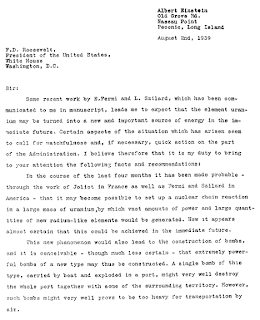
First, Einstein addressed a letter to FDR on August 2, 1939 which detailed information he had obtained while in Germany of a possible Nazi attempt at a weapon using uranium would which invoke a nuclear fission reaction to cause mass destruction. A copy of the letter is inserted below

Documents courtesy of Argonne National Laboratory
As you can see, Einstein urges Roosevelt “for watchfulness, and if necessary, quick action on the part of the Administration”—shortly after, the Manhattan Project commenced.
But, Einstein wasn’t the first scientist to suspect the need for combative nuclear research; scientists had brought the idea to government attention as early as the 1930s. So, what would make Einstein stand out from the rest so substantially to name him as “Father of the Atomic Bomb”. Well, the answer is more obvious than you may think… One of his best known accomplishments, Einstein’s famous formula E=MC2 actually made the bomb theoretically possible. Although Einstein was not explicitly a nuclear physicist and did not participate in the actual construction of the bomb, his famous formula served as the base component to the construction of the atomic bomb.
Einstein graced the cover of a 1945 Time magazine just months after the bombings of Japan.

Image courtesy of www.time.com
Einstein reduces his involvement with the bomb to a signature on the letter he wrote to Roosevelt. He regretted having any involvement with the atomic bomb and it uses; he even wrote a letter to the president urging him against dropping the bombs on Hiroshima and Nagasaki. In 1950 when Truman announced that “super”/hydrogen bomb efforts would continue, Einstein appeared on Eleanor Roosevelt’s television show with a grave warning, “If these efforts should prove successful, radioactive poisoning of the atmosphere and, hence, annihilation of all life on earth will have been brought within the range of what is technically possible” (Stone & Kuznick, 230).
Below is a video chronicling Einstein’s involvement with the atomic bomb; I found it to be both interesting and helpful.
Other Sources:
Oliver Stone and Peter Kuznick, The Untold History of the United States (New York: Gallery Books, 2012), 230.
Walter Isaacson, "Chain Reaction: From Einstein to the Atomic Bomb," Discover Magazine (2008): 1-3, Accessed February 23, 2013.
First, Einstein addressed a letter to FDR on August 2, 1939 which detailed information he had obtained while in Germany of a possible Nazi attempt at a weapon using uranium would which invoke a nuclear fission reaction to cause mass destruction. A copy of the letter is inserted below


Documents courtesy of Argonne National Laboratory
As you can see, Einstein urges Roosevelt “for watchfulness, and if necessary, quick action on the part of the Administration”—shortly after, the Manhattan Project commenced.
But, Einstein wasn’t the first scientist to suspect the need for combative nuclear research; scientists had brought the idea to government attention as early as the 1930s. So, what would make Einstein stand out from the rest so substantially to name him as “Father of the Atomic Bomb”. Well, the answer is more obvious than you may think… One of his best known accomplishments, Einstein’s famous formula E=MC2 actually made the bomb theoretically possible. Although Einstein was not explicitly a nuclear physicist and did not participate in the actual construction of the bomb, his famous formula served as the base component to the construction of the atomic bomb.
Einstein graced the cover of a 1945 Time magazine just months after the bombings of Japan.

Image courtesy of www.time.com
Einstein reduces his involvement with the bomb to a signature on the letter he wrote to Roosevelt. He regretted having any involvement with the atomic bomb and it uses; he even wrote a letter to the president urging him against dropping the bombs on Hiroshima and Nagasaki. In 1950 when Truman announced that “super”/hydrogen bomb efforts would continue, Einstein appeared on Eleanor Roosevelt’s television show with a grave warning, “If these efforts should prove successful, radioactive poisoning of the atmosphere and, hence, annihilation of all life on earth will have been brought within the range of what is technically possible” (Stone & Kuznick, 230).
Below is a video chronicling Einstein’s involvement with the atomic bomb; I found it to be both interesting and helpful.
Other Sources:
Oliver Stone and Peter Kuznick, The Untold History of the United States (New York: Gallery Books, 2012), 230.
Walter Isaacson, "Chain Reaction: From Einstein to the Atomic Bomb," Discover Magazine (2008): 1-3, Accessed February 23, 2013.
Subscribe to:
Posts (Atom)